Sub-exposed photography. Less can be more, and more can be less.
So, sub-exposed photography, it is a personal favourite of mine, especially when viewed on my phone,
the only device that I own that has an OLED panel. Sub-exposed photography can lead to nice, sharp contrasts, which
I am a big fan of, as you can definitely see on my website, especially on the Torres del Paine section
of the chilean gallery. Moody caves, overcast skies, all have their atmosphere enhanced by a lack of light, as they more accurately depict
how a person would perceive the setting, it's oppressive, but still beautiful.
Hear me out here for a second: For overcast and rainy days, or when you are inside a cave with a small amount of light leaking, the colour of
your surroundings is the purest that it can be, as there is no sunlight and/or blue-tinted sky-lighting washing out the true colours of what it
is that we are looking at, colours pop out a lot more. Have you ever looked at vegetation during the rain, and thought that it looked a lot
more green than usual? Well, that's not a coincidence! Besides some of the dust being washed off, that's because the colours of the plants
themselves are also not being washed out, which just looks right. Naturally, this logic also applies to caves or other areas
not greatly affected by sky and/or sunlight.
So, we've laid out what makes overcast (and similar) situations look as nice as they do, we get to sub-exposed photography. Now, before I get to
showing examples, I imagine that the threshold forr "sub-exposed" varies from person to person, so while I'll do my best to stick to examples
that most people may agree are of sub-exposed photography, you may disagree, and that's fine. It's also worth noting that the photographs
shown won't be just of overcast days and caves, as I also want to showcase the possible contrast that can be created, contrast that I adore.
Here we have IMG 5775 (they do not have titles, so I will refer to them by their file names), found in the Torres del Paine gallery:
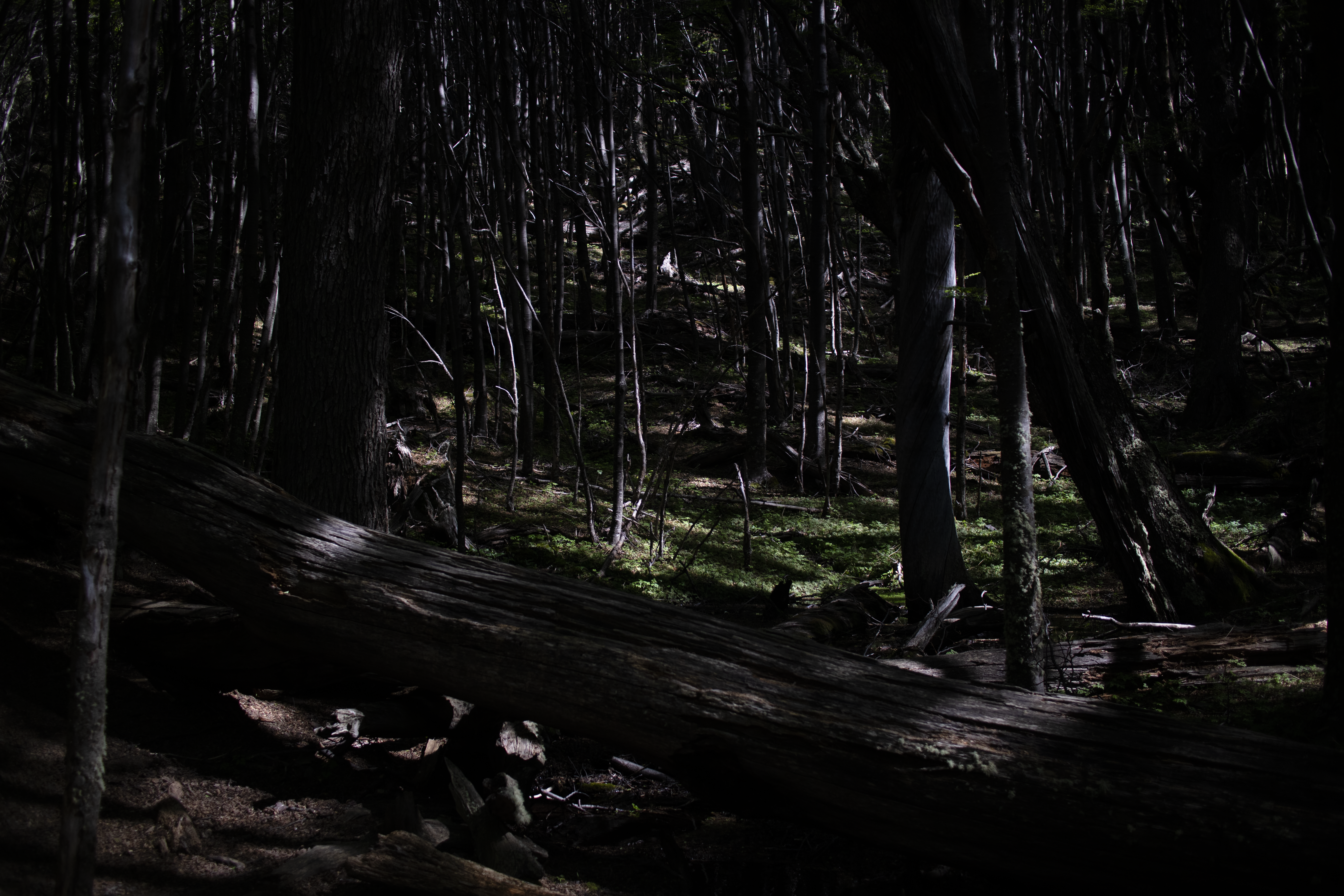
You can start making some things out in here, you can see how dark the image is, but at the same time, you are able to see all of the highlights
that are produced from what little sunlight can pass through the roof created by the trees' canopies. But it's not as if you cannot make out any
detail in the darkness that is not highlighted, (well, maybe if you're using an IPS, TN or any other similarily low-contrast panel, but otherwise)
you can still make out the detail in the tree trunks, the bark that makes their exterior makeup, the small blades of grass, the dirt,
the branches that have fallen on the ground, you can make it out, but it's only really visible if you're willing to look at the photogrpah
for a bit more. Really, what it does is it benefits those who want to go and appreciate the photograph for more than a quick glance, and if
you look at it with just a quick glance, you get a striking image with tasteful, realistic contrast, with contrast that hopefully
calls out the more interesting parts of the photograph, as is the case with the side of the trees hit by the sun, the very big fallen
tree right at the bottom of the photograph, or the sole patch of grass in the centre.
So, are we beginning to agree that accidentally taking a sub-exposed photograph is not a reason to panic? If we are, then great! Keep reading
for more sub-exposed photography. If not, then keep reading for, uuhh, more sub-exposed photography, oh and more arguments that may change your
mind, or not, you do as you please, we are all humans at the end of the day :).
Now, this next photograph is not exactly sub-exposed, but it is still quite dim, and it's one that I like, so I am going to talk about it. This is
IMG 5450, also from the Torres del Paine gallery:

I'd count it for the purposes of this post purely because it's dim, it's moody, you need to focus on it a bit in order to properly see it,
and it's definitely best experienced with a high contrast panel.
Once more we see the my intent of highlighting something, in this case, what is at the end of the "corridor", which is also the only
"well-lit" part of the scene, because it was a very nice overcast day (A type of weather that I may talk about in regards to photography
in the future). You can tell that it's cold just from the dim, neutral lighting, the haze in the background, the lively vegetation and
the moss that has grown on the rocks that are just at the end of the "corridor", just before the turn. It feels moody, and slightly oppressive
due to the naturally vignetting lighting, but at the same time, it's a bit serene, as the generally low brightness won't strain your eyes,
making the photograph pleasant to look at. Another photograph taken in the same trail is IMG 5480,
and while it's not as dim as this one is, I feel it still shares some of the same qualities, which is why I am briefly mentioning it here.
Let's go dimmer, here we have, from the Italian gallery, IMG 5014:

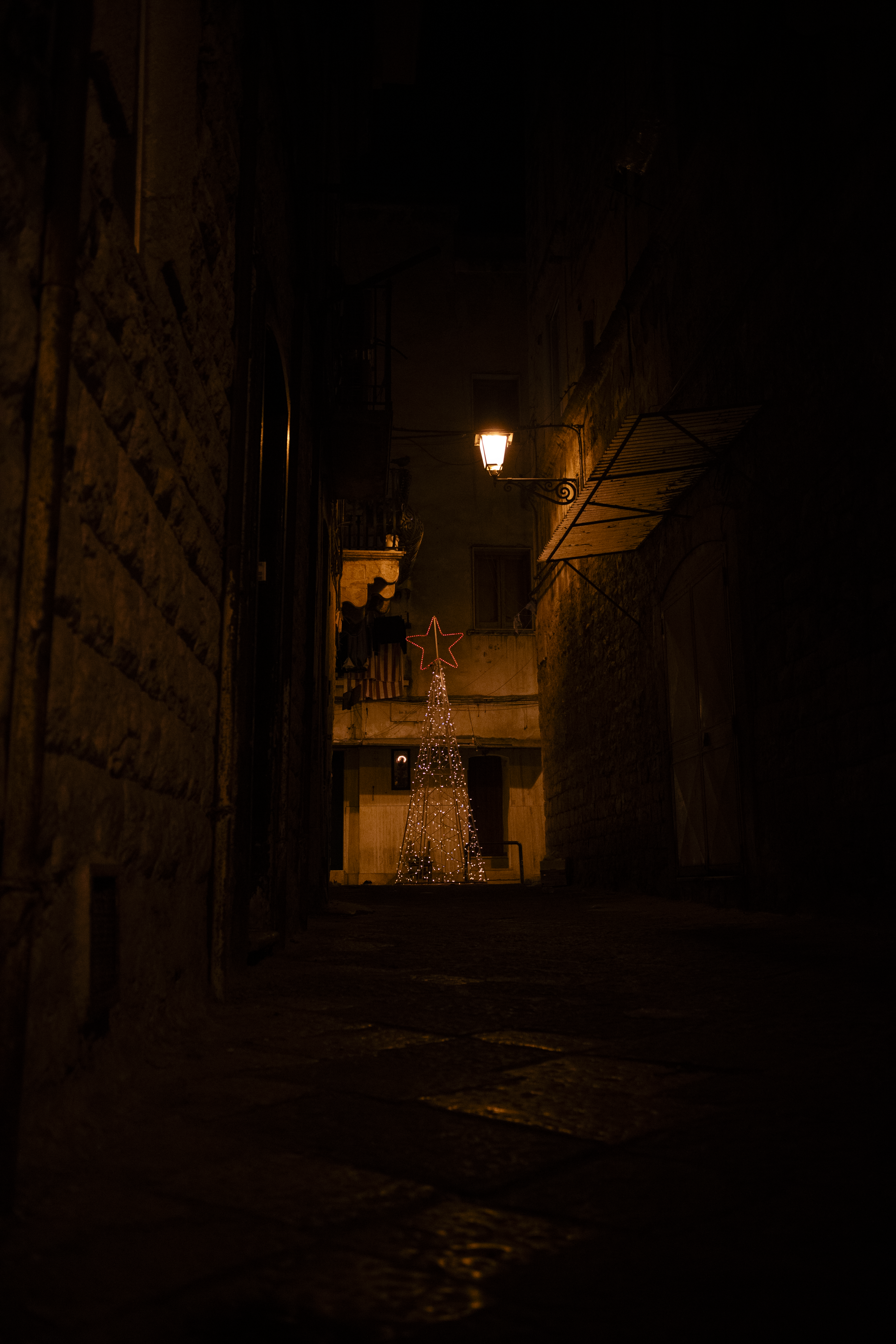
Another "corridor", one with one clear highlight, being the light hanging from the building, and one landmark, being the thin christmas decor.
The lighting is monochromatic, dim, warm and, because of how dim it is, noisy, and it is accompanied by a very old alleyway in the south of Italy,
an alleyway that harbours a frail christmas tree, all seen from below and close to a wall, making the image feel slightly more imposing,
and the setting slightly more frightening. None of this would work if photograph was taken with a long exposure so that the patches of what looks
like pure darkness could be revealed, it would lose the eery touch that I think adds a lot to the final image.
And now, to close it off, an example of an over-exposed photograph, in this case, an alternative shot of IMG 5775 that I took, a shot that is more
exposed. I don't have it properly on the gallery because I am not a big fan of it, but it's fitting for the blog, so here goes IMG 5774:
Now, this isn't as offensively over-exposed as an existing IMG 5773 (which I won't talk about
due to it being too horrible to use to carry out a productive conversation), I still prefer how it looks when sub-exposed, as now everything
is a highlight, you don't have to look too hard for the grass, and you actually see more of it more easily, which I find removes a lot from the
scene. Before you could clearly make out the highlights, even if said highlights were numerous, but now because everything is a highlight, nothing
is, which I find takes away from that I like about the scene, and what originally made me stand still for a bit to take the pictures that I did.
The detail is now plainly visible, making the image noisier (and it was already quite noisy to begin with), overloading it.
The dimmer lighting made it so that the unimportant details wouldn't be revealed to the viewer unless specifically sought them out, making it
easier to take it in.
I think that'll be all for my ramblings, I didn't intend on this post being too long (and really, it isn't long). I don't think I can provide
enough insight to the topic to the point that I wouldn't be going on in circles, even if I feel like I did that with just 4 pictures, hell, I
don't think I even have the most fitting photography for this, or at least not currrently exported photography, but that's besides the point.
I hope that this was an enjoyable read for you, and wherever you are in the world, I hope that your day is excellent, and that you have a
good morning, afternoon, evening or night!